The Unfolding Path: From Solo Code to Orchestrated Teams
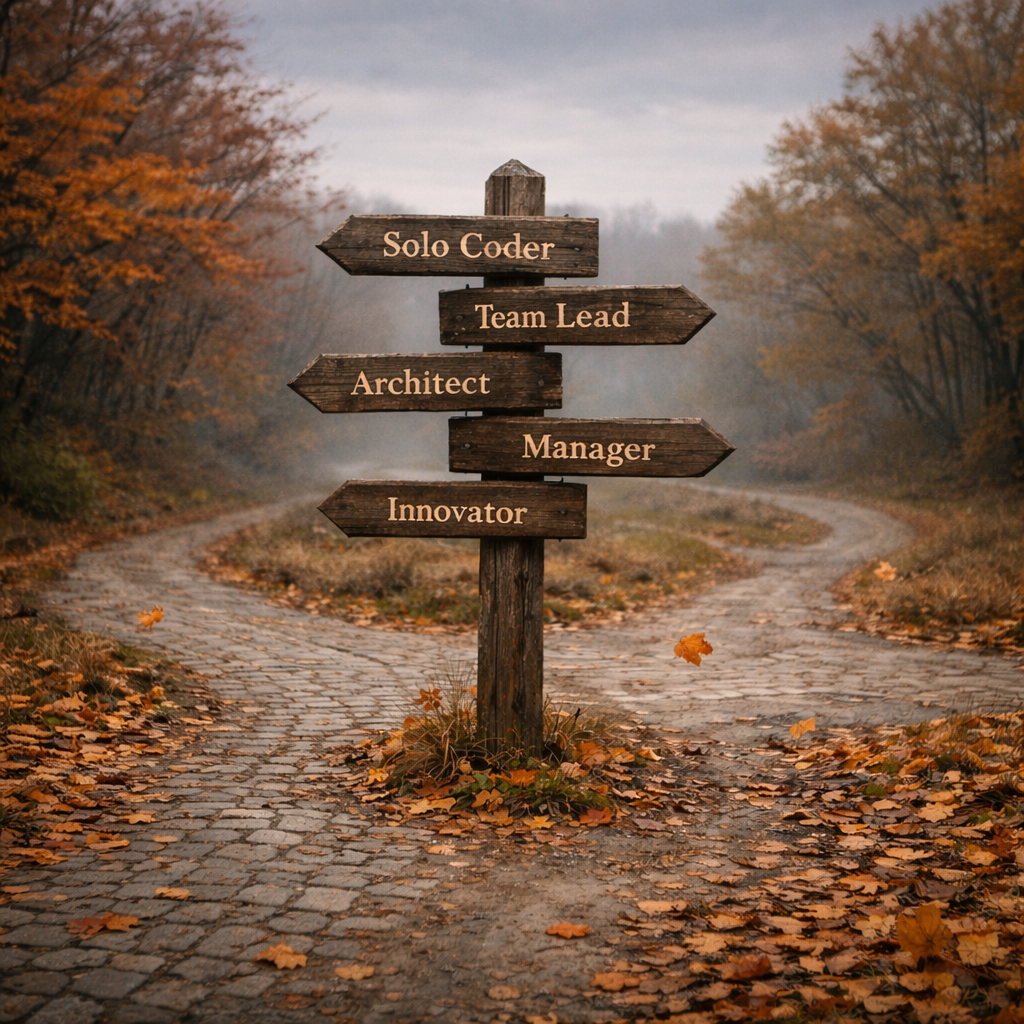
It’s an odd request to ask a bot to synthesize your own career evolution, but in 2025 what isn’t a bit odd anymore? Looking back through the digital breadcrumbs of this blog a narrative emerges of a software engineer slowly (sometimes grudgingly) learning that the most complex systems aren’t built in code, but in the intricate dynamics of human interaction. This transformation took me from a coder focused solely on my screen to someone concerned with making teams work and getting people to collaborate.
The Early Trenches: Code, Boundaries, and the Lone Wolf Mentality
My earliest posts from 2008 and 2009 show a developer focused on personal output and survival. This focus led to a fierce protectiveness of personal time, a natural reaction to the often-unending demands of project work. That relentless pace stemmed from working at smaller companies in a fast-moving industry, compounded by my personal drive to prove myself.
In 2008, I wrote about managing scope creep. The core message was simple: don’t let work consume you. This post came from a genuine desire to establish boundaries against the relentless push for “one more feature.” My work relationship at that stage felt largely defensive. It was about my time, my efforts, and avoiding exploitation. Personal well-being was vital, but it also highlighted an individualistic approach to navigating the professional world. The team seemed an amorphous entity imposing demands. The client was a force to be managed.
Shortly after, “Get Your Boss to Do What You Want” explored workplace dynamics, but still from a deeply individual perspective. The advice to “plant the seed” wasn’t about open collaboration or shared vision. Instead, it described a subtle, indirect tactic to exert influence upwards. The goal: getting my ideas adopted without direct confrontation. This showed an awareness of hierarchy and power structures. Still, the aim remained individual success or validation. The team, if it existed beyond my immediate manager, was not the central actor. I was the protagonist, trying to bend the system to my will, or at least to my good ideas.
Looking back, a lone wolf mentality defined this era, or maybe it was a highly effective individual contributor mindset. Solving the code itself was the primary problem. Managing my personal workload and navigating the immediate hierarchy came next. Human interaction served as a means to an end, not the core challenge. Today, I’d approach similar situations with open dialogue and transparent collaboration, focusing on shared goals rather than individual influence.
The Slow Thaw: Understanding the Other Side
As the years progressed, a subtle but significant shift emerged in my perspective. Less about individual friction with organizational processes, my thinking moved towards understanding the broader professional environment. This change became evident in my reflections on “The Interview Process”. I still gave advice, but it stemmed from observing both sides of the table. I understood interviews were a two-way street; the company also tried to win over candidates. The emphasis on authenticity and passion hinted at a growing appreciation for personality and fit, not just technical prowess. This was a crucial step: thinking about team building and the human elements that create a cohesive group, rather than just individual performance. It recognized that talent involved not just knowledge, but also who someone was and how they might integrate.
This period was a slow thaw, an increasing realization that software isn’t built in a vacuum. It’s built by people, for people. And to build good software, you need good people, working well together. The questions I was asking myself were no longer just “How do I do this better?” but “How do we do this better? And who are the right we?”
The Agile Awakening: People-First and the End of the “Agency Agile” Joke
My thinking about team dynamics clicked around the time I wrote about “12 Months of Agile” in 2019. By then, I had witnessed enough “Agency Agile”—a superficial process implemented without understanding its spirit—and grew disillusioned. My earlier jokes about it lost their humor; ignoring the human element had painful consequences. My understanding evolved past methodology, becoming a philosophy and marking a conscious, deliberate shift. The statement, “my job is less about writing code and mostly about figuring out what problems people are having,” was a revelation. This fundamentally changed how I viewed my role. I realized bottlenecks, miscommunications, and frustrations usually weren’t technical; they were human.
Embracing the Agile Manifesto’s core tenets—especially “Individuals and interactions over processes and tools”—transformed my understanding. I saw that creating a strong vision then getting out of their way defined effective leadership and team empowerment. This shifted my focus from subtle influence to active facilitation, clear communication, and trust. The team was no longer an obstacle or distant entity; it became the engine. Understanding its mechanics, its people, and its interactions became paramount. I viewed my role as an enabler, a problem-solver for people, not just for code.
Navigating the Future: AI as Collaborator, Communication as Superpower
Fast forward to 2025. My recent experience marks a mental shift in my people-first perspective, particularly as technology dramatically changes. I initially viewed AI as an “existential threat” to my career, a fear of being left behind, a sentiment I explored in my reflections on surrendering to AI masters. Yet, after a year of reflection and constant trial and error, it clicked: AI is a powerful tool. I’ve evolved from seeing it as merely an extension of my IDE into something I can run multiple instances of, performing many tasks simultaneously. This extends my evolved thinking about teams. Collaboration is no longer just human-to-human; it now encompasses human-tool interaction. I realized AI demands precise communication, structured intent, and clear articulation of underlying “values”—a powerful metaphor for managing human teams. If I cannot clearly articulate expectations to an LLM, how can I expect a human team member to intuitively understand them? AI has become a tool forcing me to be a better communicator, a better leader of thought, even if the “team member” is a silicon brain. This shift also heavily influenced my observations about the tech job market today.
The job market for software engineers reflects an industry in flux. The solutions presented aren’t just technical skills; they demand architects, decision-makers, mentors for other developers, and those who bridge technical and business requirements. These are deeply human, collaborative, and leadership-oriented skills. The market now rewards strategic thinking, the ability to orchestrate efforts, and the capacity to solve problems AI cannot yet solve—problems often residing in the messy, nuanced realm of human needs, business context, and complex team dynamics.
The Unfolding Path: Always Getting Better Together
My career trajectory, viewed through this blog, marks a journey from individual focus to collective impact. It shifted from asking “How can I protect myself from the demands of work?” to “How can we—a cohesive unit of humans—best navigate challenges, create value, and continuously improve?”
The core philosophy of this blog remained constant. Its application broadened exponentially. I moved beyond just improving my code. Now, it’s about improving communication, team processes, leadership, and the collective intelligence of the systems and people I interact with.
The software engineering field is, at its heart, a problem-solving endeavor. I’ve learned that the most interesting, challenging, and rewarding problems don’t reside solely in elegant algorithms or robust architectures. They exist in the intricate, unpredictable, endlessly fascinating world of human beings working together. In 2025, with AI woven into our work’s fabric, leading, collaborating, and communicating effectively has never been more critical. It is also more personally fulfilling to continually refine. It seems the journey to “Always Get Better” always led me to understand that the greatest accomplishment lies in building not just great software, but great teams.